7/21/2020

Stop saying I am sorry, when it is not necessary.


Why say “sorry” when “I’m not really sorry.”

Apologising unnecessarily can have negative effects on both your personal reputation and your view of yourself. While you may think you're being kind or empathetic, saying ‘I’m sorry’ too much can give off the appearance of incompetence and undermine your authority or expertise with colleagues, managers, and clients, friends and lovers among others. Over the years, I've heard dozens of younger people -- especially women -- apologizing profusely in the workplace, and in social settings, even when they've done nothing wrong! This tendency to apologize is simply not a good thing; it affects the way young professionals feel about themselves, and it can even set them back in their careers, and put them in a disadvantaged position in relationships. If you're starting out in the workplace, you need to believe in your actions so deeply that you stand behind them, or else rethink them all together. If Another Woman Is Being Rude or Uncivil to You at Work, Here's What You Can Do Unnecessary or avoidable apologizing can hurt your professional self. Why? Because apologizing when you've done nothing wrong isn't fair to yourself, and apologizing too often can lessen the power of the words when you've actually made a mistake. If you apologize too much, your audience will no longer accept it as legitimate. The apologies become irrelevant and exhausted. As professional women's coach and TEDX speaker Melody Wildling notes on her blog , apologies that come across as insincere break professional trust and set women back in achieving their goals. Most people can admit that they've used the phrase "I'm sorry" as an easy way out. Sometimes rushing to admit fault makes it easier to ignore mistakes, because you feel like you've made amends by quickly acknowledging you were wrong. Some people saying "I'm sorry" -- whether they mean it or not -- wash their hands of the issue, and move on. Ever done this? Everyone has. But, apologizing does not course correct, or offer a solution. Many times, we'd be better served by removing the "I'm sorry" and replacing it with something more valuable. Related: How This Founder Uses Obstacles as Inspiration: 'I'm Making Lemonade' The potential downsides of "sorry" raise a lot of questions. What happens when you do make a mistake? How does an apology then affect our professional lives? How can we avoid an apology while still acknowledging change is necessary? And when do apologies really have a place? To figure these out for yourself, follow these three steps. 1. Instead of apologizing, offer a solution. If you took a misguided approach to a task, rather than making a conscious bad decision, you can offer a solution to your mistake instead. For example, if you sent an email to an important client, but there is information missing and you need to send an additional email. Skip the "I'm sorry, forgot one thing!" or "My apologies, here is the missing information," and move right to the "In my last email I did not include “X” Below are the additional details." You have not admitted fault, you have simply corrected a mistake. You can take it further as well. Maybe it's your boss who noticed the mistake, and now you have to fix it. Instead of "I'm so sorry I forgot that information," try "You are correct, I did not include that information, I will send it right now." Working like this makes you look polished, professional and confident and shows that you're willing to do what's needed to keep things moving. The more you can proactively address your mistakes, the better your professional performance will be. A 2010 study found that the most important factor of a successful apology is that the person who made the mistake can demonstrate empathy, which usually requires time. People who say “sorry” too quickly give the impression that they haven't really thought through all the repercussions of their actions. Prove that you don't see your apology as a get-out-of-jail-free card by talking through why mistake is important and really trying to fix it. In this Era of #MeToo, Telling Women to 'Lean In' Does More Harm Than Good. Try trading remorse for gratitude. Let's say you're late to a meeting. Your instinct might be to say, "So sorry, I'm late!" Instead try "Thank you for your patience." I have personally used this technique and have found that expressing gratitude instead of remorse or regret completely changes the tone you set when walking into a room or starting a conversation. You are acknowledging the issue in addition, yet setting up a positive environment for what's to come. Saying thank you shows that you are respectful of the other  person’s time, but keeps you from looking critical of yourself. "Sorry" can make you look -- and feel -- inferior to the people you're dealing with. It may affect the way they look at you, or worse -- the way you feel about yourself. An Ohio State University study validates something you might already know: Poor self-confidence seriously hurts young people with professional and personal  goals. If you believe you are bad at your job, you won't aim as high as you otherwise might. Mentally categorizing missteps as "offenses" is a dangerous practice, and it disproportionately affects young women. According to the Association of Psychological Science , women report not only apologizing more often than men, but also doing more things "wrong." It's not that women just apologize more -- it's that they perceive more mistakes in themselves. That isn't accurate, and it isn't healthy. Ladies head Into Your Next Male-Dominated Meeting Ready to Contribute by Following These Tips; Conclude with a real, authentic apology. Sometimes, the situation still calls for a downright apology. Such is life! To understand if the situation truly warrants words of atonement, ask yourself honestly whether you've made your most conscious decision, explore other unapologetic avenues, and see if you still believe an apology is necessary. This is the only good recipe for a genuine apology. This authenticity is necessary for an apology, and without it, the apology is useless. This thoughtfulness in deciding to use an apology, after exploring other tactics for problem solving, will help you make conscious decisions about apologizing rather than using apologies senselessly. When you say “sorry,” the other person will know that you mean it. If you are conscious in your choices and have strong, thoughtful reasoning for your choices, you should not have to apologize. In other words, you are who you are, and if you are living authentically and consciously, there is no apology needed. If you do make an error and truly find that it's time to apologize, then the "sorry" you give will really count.


Final thoughts

It takes great efforts to stop doing what you have been doing for many years. Women (especially black)  have to stop feeling like they have something to apologize for. If you think you are right don’t say “sorry” in any part of the sentence. Part of the problem is that women often allow others to validate them, even when the women are in the strongest position. Women apologize too often, it’s as if they they are saying “I want to be judged by you”, “if your judgement  of me is negative then let me apologize for wasting your time.” Or  “If your assessment of me is positive let me apologize for making you feel  less important than me!”


7/05/2020

PLease do not Compare me to someone else

Are you my soul mate? Your spots remind me of someone his behaviour never changed he was always hunting for new prey!


We all make the mistake of comparing  folks to other people we once knew.

Men do it by say stupid stuff like she reminds me of that model or movie star. As if she will like the comparison and treat his words  like they are compliments. 

Women seldom compare men to movie stars they compare them to other men they may had experiences with.

 So how do we fix these stupid comparisons that seldom have good results. We need to talk less about other people and accept folks for whoever  they are. Sounds simple but it’s not so simple. If a man learns how to flirt with a woman he would never ever say to her you remind me of so and so. Women may not tell you that you remind her of Mr. So and so, but her reactions to the things you do and say may take her there into the deep resesses of her memory. You would have to be a mind reader to get what is bothering her about you. I met a lovely womana few years ago she told me she thought I was someone else…. Which translated to me she thought about someone else when she thought I was him. Only God knows what she was thinking. And since I didn’t see it as a compliment I didn’t ask her to tell me about  who ever it was that she thougth I was. My initial attitude may have triggered something in her mind. Having initials  BAD is never a good conversation starter. She is not looking forward to being in relationship with someone who is advertising that he is B.A.D. guy. Especially if she is a good woman.

Her body language will speak volumes. You have to read what she is telling you.


Most men  would love for a woman to see him as the guy that will rock her world but not remind her of the guy she once knew who look just like Atlas.


Final thought

Let’s face it comparisons are never a good thing for either gender. 

You comparisons most often conflicts with the way the other person sees themself. 

Just compliment the other person without say you remind of  whoever. Or you look so much like so and so, A by all means do not refer to the other person as a Barack or Michele Obama look alike. They will never see it as a compliment. 


6/28/2020

So you think you've met the "One"

This lockdown is so cramping our style?

Meeting the "one" before/after a lockdown. 
The coronavirus crisis is putting all our relationships to the test, from home-working couples juggling emails and childcare to unattached friends trying to offer mutual support remotely, at a time when many without partners feel more single than ever.
But some have really thrown themselves in at the deep end and are navigating the “new normal” with people they’ve never previously lived with or have only just met. Some have called the trend “corona cuffing”, others are dubbing these couples “coronnials”.

The vibration of a mobile phone breaks the silence of a motionless Milan night. At a dinner table set for one, Giulio clears his voice before answering. Lorenzo, his Tinder date, appears on Giulio’s cracked iPhone screen wearing a black hoodie and a black earring – he seems to be smiling behind his thick beard but there is silence on the line. Perhaps he’s embarrassed, thinks Giulio, or maybe it’s the poor internet connection. A moment passes, then Lorenzo breaks the silence. “Hey ciao,” he says, “Sorry I’m late.” “It’s okay,” says Giulio, “I don’t have to go anywhere.” 
Giulio considers himself a master of dating in ordinary life, but for now he has to settle for on-screen flirting. He misses the warmth of a handshake or the electric feeling of a kiss, he told me when we spoke, though one thing has become easier about meeting new people: finding an ice-breaker is not a problem. He listens as Lorenzo describes his days in quarantine: alarm at 8am, push-ups in the living room at 9am, remote working until 6pm, a nightly chat with parents, then an episode of Netflix crime drama “Ozark” before bed. Lorenzo launches into a description of his third day under quarantine when Giulio interrupts: it’s all starting to sound a bit repetitive.

If there is a positive side to the lockdown, Giulio thinks, it’s that it has paradoxically broken down barriers: everyone is stuck in the same situation, living the same emotions, having the same thoughts, asking the same questions. He wants to see Lorenzo again, but chooses not tell him when, for now. After an hour-long video call, they hang up with a hasty “talk to you soon.” Giulio – with slicked back hair, white shirt, pyjama pants, furry slippers and wearing Gucci perfume no one will smell – rises to stretch his legs. The lights of Milan wink at him through the window. In the deserted street a pharmacy clock reads 22.52. There is plenty of time for a cigarette before his next date of the evening. 

Italy was the first European country to impose a nationwide lockdown in response to the coronavirus pandemic, banning public gatherings and closing schools and universities in an attempt to stop the spread of the virus. Lombardy, which has been quarantined since March 8th, is the hardest-hit region. It has recorded around 14,000 cases of infection and over 2,000 deaths so far. Milan, a city of 1.3m (and over 1,700 cases of infection), is in the heart of it. On March 11th, as the death toll rose dramatically across the country, a government decree imposed the closure of businesses, restaurants and bars and placed severe restrictions on people’s movement, allowing them to travel only for “essential” reasons. As Giulio put it to me when we talked about his online date: “Che sbatti!”– Milanese slang for “It sucks!” But life – and love – goes on.
I have not seen my friends since the first day of lockdown, so I decided to arrange an “aperichat”. Aperitivo via Skype has become Milanese’s first antidote to abstinence from social life and, of course, from beer: groups of friends meet on video calls to drink and chat as if they were sitting around a bar table. It’s not a date and my friends and I don’t need to break the ice, yet the conversation always begins in the same way: “Well, how’s the lockdown going?”
A guy ,  with an unrequited passion for guitar, tells us about his attempt to emulate those who, in the last few days, have been singing songs together on balconies all over Italy. “Yesterday I went out on my balcony and started to play Guccini,” he says , “but the only reaction I got came from an old neighbour who pulled down the shutter. I pictured her thinking: ‘Wasn’t coronavirus enough? What have I done to deserve such a punishment?’” Mirko, a freshly married salesman, tries to push Edoardo and his girlfriend to tie the knot: “Now that you’re sitting around the house, you can finally propose,” he says on the screen. Edoardo blushes and tilts his curly head until it is out of the Skype frame. Federico runs to his rescue: “You’re lucky you can’t go out and buy an engagement ring.” The quarantine is putting many relationships under strain (lawyers have said they expect a spike in divorces after the crisis is over) but despite being trapped 24/7 with their partners for the first time, so far my friends are proving the strength of their bonds.
Final Thoughts

6/27/2020

Happiness is a choice,


Not a result. Nothing will make you Happy

until you choose to be happy.

No person will make you happy unless 

You Decide to be happy. 

Your happiness will not  come to you. 

It can only come from you

~ Ralph Marston


Since I believe that this quote is very accurate, I have to rethink the many  times I tried my utmost to make a female happy, but failed miserably, because during that time I was personally unhappy to start with. Like Chris Rock said in one of his stand up comedy lines “ you can’t make a woman happy, it’s impossible”

What he did not say is that “she first has to be happy to connect with you and you both bring each other happiness!”

We  are either happy or we  are not. If a man takes up the task of making an unhappy  woman happy he will not succeed. Men get tricked into thinking that what they do for women will make them happy… they are fools if they truly believe that. If a Women and a  man meet she has to already be happy to be a continuously  happy woman. he can keep her happy by doing the things she likes. However if a man meets an unhappy woman no matter what he does will change her unhappiness, shehas to bring her own happiness . Nothing he does will change her, until she chooses to change and be happy. Her happiness will not come to her, it has to come from her. Every woman who ended a relationship and was unhappy will bring that unhappiness into a new relationship, she first has to heal and get over her unhappiness, and turn her frown right  side up into a smile before she can enjoy the new guy that will  enjoy the happiness coming from her.

I’m so happy now that I’ve  let go of my unhappiness!

Think about it this way, If man walks up to a smiling woman he can keep her smiling because he met her smiling. But if a man walks up to an unhappy woman, no matter what he does it will not change her mood, until she decides to change her mood herself. When her mood changes she will bring a different energy to the mix. And Vice Versa


You brought me and additional smile of happiness

 that has enhanced my happiness that caused me to smile too.


Final thought.

Many of us  have wondered why we could not make the other person we were with…. happy. The reason is very simple, you first have to be happy to bring new happiness into the life of someone else. If you are miserable you can not suddenly energize that positive energize (because the negatively is ruling that space, and where there is negative energy positive energy will not reside at  the same time, the positive  will cause a spark when it meets the negative, and may even start a fire, and not in a good way. Bodies have electromagnetic charges that stretches out about ten feet. If a negative charge encounters a positive charge. It will not turn it into positive charge, it will bounce off of the negative

Men and women who carry the weight that they failed to make their partner happy should relieve themselves of the burden because the other persons unhappiness was not their fault.


Is he causing her to smile in her dreams?

The answer is “no” he is not doing it... she is happy in her own head this is causing her to smile, and his image in her head is enhancing the result.... but he not physically the cause.

She is choosing  to be happy


6/13/2020

A man is often confused by the many comparisons, women use to validate him


“You are just like….!” Why does that statement bother me so much?


Men through out the ages have heard it so many times that they are “just like someone,” be it their fathers, other members of their community, their race,their gender. 


Men from the time they are born are being compared to others. You look like your dad, your grandfather, “you behave like all the other men I’ve known”, “You are this or that just like,,,,”

Why is this such an association problem? It is somewhat simple, to figure out if you take the time to understand what is happening.  Many young black men grow up not really knowing their fathers, their only point of reference is what they were told about  by others, be it their mothers, grandmothers and even strangers.

Men have to analyze what all of these comparison really are doing to them mentally. If a man is just like someone, is that the speaker an admires then it’s a good thing, but if it’s the reverse then it’s for sure a bad thing. Women do it and do not know how damaging this can become, because these triggers are loaded with false narratives.

Men have live with comparisons of inadequacies  or whatever guilt trip these comparisons have been lay on us.

A man has to live with his short comings and comparisons. They learn to hate these false narratives…. 


Society have stereotype men so much that many guys have trouble living up to many of these stereotype. Weaker men can let this stuff depress them, they feel inadequate, if they feel like they can’t live up to whoever they are being compared to.

I knew that after some training you would behave just like Denzel Washington


The most frequently expressed complaint women have about men is that men don’t listen. Either a man completely ignores the woman when she speaks to him, or he listens for a few heart beats, assesses what is bothering her, and then proudly puts on his Mr. Fix-It cap and offers her a solution to make the woman feel better. He is confused when she doesn’t appreciate this gesture of love. No mater how many times she tells him that he’s not listening, he doesn’t get it and keeps doing the same things. She wants empathy, but he thinks she wants solutions.

When a man has made a mistake and feels embarrassed, sorry or ashamed then he needs her love and appreciation more….The bigger the mistake the more points he gives her for expecting the best from him.

But women can push a man away, just when he thinks he has made the grade

Dude, I'm busy working, STOP texting me!

Final thoughts

Men often are not sure what women are using as data to validate them.

Women can reject a good guy because she wants a "B" bad boy, to excite them.

the following tells a story


6/10/2020

Keep your 6ft distance from me Please

So how has social distancing affected your chances of meeting someone new who is worthy of your attention.
I knew you were "the one" the minute I saw you across the room.

We’ve all heard the advice from public health officials: stay at home, wash your hands and don’t touch your face! We’ve cancelled sporting events, concerts and other mass gatherings; closed schools, libraries and playgrounds; and asked people to work from home wherever possible.

But as we enter into this extended period of social distancing (also called physical distancing), many might be wondering whether giving up in-person recreational time with friends and family is worth the potential harms to our social and emotional well-being.

Some may be asking: “Can I keep seeing my friends and family, but in a safer way?” But taking a risk-reduction approach to social distancing for COVID-19 won’t work.

Risk reduction (or harm reduction) refers to public health strategies that minimize the risks and related harms of certain behaviours, without expecting people to stop engaging in those behaviours. Examples include using condoms during sex or wearing a helmet while bike riding; people still practise these behaviours, but they do them less often or in a safer way.

When it comes to COVID-19, those considering a risk-reduction approach to social distancing may be thinking: “Is it OK to take small risks, such as visiting my parents for the Easter holiday if we’re all symptom-free? Or meeting up with my running group if we stay two metres apart? Or seeing my elderly grandmother in a nursing home if I’ve been physically isolating for 14 days?”

The short answer, sadly, is no.

Understanding the risks

First, COVID-19 is primarily transmitted by respiratory droplets produced when someone coughs or sneezes, and the virus can live on surfaces for several hours or even days. Even people who are practising social distancing can be exposed to COVID-19 when doing essential activities like getting groceries or exercising outdoors.

This means that even if you are staying at home and practising social distancing, it’s still possible to have been exposed to the virus and not even know it. Because people infected with COVID-19 can be contagious before they start showing symptoms, every close contact with someone else — even if they are asymptomatic — risks transmitting the virus. So, no, you can’t go visit your grandmother even if you have no symptoms and you’ve been physically isolating for 14 days.

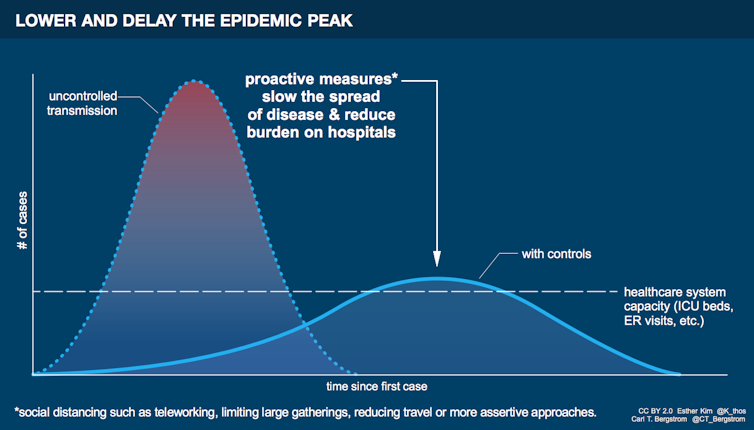
Second, social distancing will only “flatten the curve” if everyone who is able to remain physically separated does so. This will keep the number of active cases below the health-care system’s capacity and increases the likelihood that those who need care will be able to get it.

Flattening the curve distributes transmission over a longer period and keeps it below the capacity of the health-care system. (Esther Kim & Carl T. Bergstrom)CC BY

You may perceive your individual risk to be low, but the reality is that everyone is vulnerable to COVID-19. Social distancing protects not only you, but those in your communities who are at higher risk for severe disease, such as older adults. Even seemingly less risky social encounters with friends or family can prolong our time under social distancing measures.

Third, some countries are now seeing more cases of COVID-19 that were acquired in the community, where the source of infection cannot be linked to a known case or other risk factors, such as international travel.

This is why the public health response has transitioned to broad population-wide approaches like social distancing, which aims to slow the spread of the virus and prevent our health-care system from being overwhelmed.

Finally, no specific treatment for COVID-19 currently exists. Unlike seasonal influenza, where we have vaccines that provide some protection and antiviral drugs that might reduce symptoms, effective therapies for COVID-19 will take months or even years to develop.

About one to two per cent of people infected with COVID-19 will die of their infection (versus about 0.1 per cent for seasonal influenza), and it only takes about three to four days for the number of cases to double. Given these characteristics, loosening social distancing measures, despite how safe it might seem, can increase the number of people who will require admission to hospital or tragically die from this infection.

Redefining social interactions

What would a risk-reduction approach for COVID-19 look like for our more recreational social interactions? The risks of COVID-19 are not going to stop people from being social, any more than the risks of sexually transmitted infections or head injuries stop people from having sex or riding a bike.

During the COVID-19 pandemic, the metaphorical equivalent of using condoms and wearing a helmet is not to have less frequent social encounters with friends and family. Rather, we must redefine what those social interactions look like.

According to public health experts, this could include virtual meet-ups with friends or colleagues, calling or texting a friend you haven’t seen for a while, hosting an online book club or movie night or spending family time with your household members.

These types of interactions are important for everyone, but especially those members of our society who live alone, or the one in five Canadians who experience mental health problems. We should still strive to stay socially connected, albeit in a different, more virtual way.

Until the virus is brought under control, practising strict social distancing, combined with other public health measures like widespread testing and vaccine development, will be critical in controlling the spread of COVID-19.

Final thought

I saw the above article and it got me thinking.  I even became lazy didn't want to do all the research to write a post. this article has enough information that I could just copy and paste. However my two cents is needed to complete my thoughts.  we have many good reasons for keeping our distance from each other... hopefully this will not last too much longer. People are social beings. we need to interact. Yes we have Zoom conferences or Skype, and facetime conversations but actually getting close is what we need to feel the other person, really get to know that person worthy of our attention. 

This reminded me of the movie "fatal attraction", 


and few others that forced cheating husbands to change their ways (for short period of time), Because meeting someone new could lead to a fatal finality. Here is were we are again in a same kind situation. COVID-19 is not an STD. these days people walk around claiming that they were tested for STDs. Maybe maybe not. in this case, a transmitted crossover  from a kiss can really  kill you!  Let's hope we can get to the  other side safely and " the curves" we talk about in the future is not just lines that bends.


Do you like my curves?


6/02/2020

Women seek relief through talking.


We men need to understand that women instinctively feel the need to talk about their stresses, and issues. 

Do you understand what I’m talking about?   Or are you just tuning me out, and pretending to listen?


A woman under stress is not immediately concerned with finding solutions to her problems but rather seeks relief by expressing herself and being understood.

So how do men react when women need to talk? Men either become protective or want to excape.

When women talk about problems, men usually resist. A man assumes she is talking with hiim about her problems because she is holding him responsible. The more she talks about problems the more men feel blamed. Men do not know that the woman just wants to talk to feel better. A man (because he is assuming) does not know that she willl appreciate it if he just listens. 


This is all your doing, you had to mess up a good thing didn’t you?


Men talk about problems, for only two reasons: men are blaming someone or they are seeking advice. Because a man lacks the  understanding of how women feel. He assumes she is blaming him, then he draws his sword to protect himself  from attack. In both cases, he finds it very difficult to listen.He strikes back and she just starts thinking it’s not worth it to have a conversation about problems with him. We need to end this!


If we can’t just discuss things 

without arguing then what do we have?


We  men may need to seek professional help in these trying times. 

Men also become impatient when women talk about problems in great detail. A man mistakenly assumes that when a woman talks in great detail all details are about him for him to find solutions to her problems. Men struggle to find their relevance.If he offers solutions, he expects her to feel better.This is because men feel better with solutions, as long as they have asked for a solution to be offered. But when she does not feel better, he feels his solutions have been rejected, and he feels unappreciated.

A woman might make any comment as a way of expressing her worries, disappointments, and frustration.She may know that nothing more can be done to solve the problems, but to find relief she still needs to talk about them. 

To forget her own painful feelings a woman may become emotionally involved in the problems of others. Women need to bond with other women so that they can feel all that they want to feel without having to defend, the assumptions that men make. 


Final thoughts

After a few years of being  single again(divorced), I came to the realization that I didn’t always understand women. I thought I did but I was wrong very often when I thought I understood the things that women really wanted. Not all women want the same things. Some women are not  wired for all the vows, they are just in it for-better, for richer and in-health parts. But not the rest as much.  Some are not strong enough to love another person during the for-worst, for-poorer forever parts. People mess up, make mistakes, say hurtful and do hurtful things.They are loveable for a period time. But they are hard to love for-ever and ever, no matter what.

Men  assume that women are into the full vows pledges. But some women are not. If a man is not committed to the vows most women have learned to accept that, because men will be men! But men are not always ready to accept it when a woman stops loving him for what seems like no good reasons, to him… like his mother loved him and his dad until death did them part. Some of these Women are not always so different from men when it comes to commitments. These Women want out of relationships sometimes, they just want to move on with their lives without the man they were somewhat committed to.


These secrets are not shared in the beginning or even in the end.